
Christmas at the Post Office
There was a queue. News of the lieutenant’s dog had spread, and it wasn’t just the residents of Sakskøbing who felt the urge to send their Christmas mail from Sakskøbing Post Office. The dog sat poised beside Lieutenant Nielsen – as each Christmas card was placed on the counter and a stamp torn from the sheet, the dog stretched its neck and stuck out its tongue, ready to moisten the stamp ready to be used. The queue stretched out onto the pavement, and conversations flowed as children and adults grew restless, some perched halfway up the steps. But, the notion of going somewhere else – or buying extra stamps and applying them oneself – was unheard of.
Christmas was approaching, and the town’s decorations transitioned from the inn’s poster declaring, “One votes Rørdam, another votes Gjørtz. But most prefer a Tuborg first,” to “Christmas Ball in the Banqueting Hall” and other similar advertisements from the Artinans’ guild, the dance school, and countless other local associations. The festive shopping season was in full swing, and it had spilled over into the post office’s bustling atmosphere. People were buying all sorts of items to be packed as gifts for loved ones near and far. Many families had relatives elsewhere, and the gifts were often wrapped beautifully in-store at the customer’s request – some opting for extra protection for items destined for a rough journey – others later secured at home with layers of newspaper and strong brown wrapping paper. The post office offered both paper and twine at a special counter, equipped with a large roll of sturdy string. Both supplies vanished quickly. Some wrapped their packages on the spot, while others took the materials home for a quieter preparation – perhaps for parcels that weren’t actally Christmas-related.
Yet the festive spirit was in no short supply. Sometimes, carollers took station outside, singing with outstretched hands and caps jingling with a few enticing coins, to prompt the more hesitant passers-by. The money was for Christmas charity for the poor.
Jenny and Michael had been allowed to visit the post office alone, carrying a stack of Christmas cards. Like everyone else, first they stood on the steps, gazing up and down the street and across to the snow-covered train station, where the snow was slowly beginning to melt. One could tell by the way people walked that it was slippery – cautious rather than brisk steps – and in certain spots, it was downright dangerous. The town’s children had been busy creating icy slides, polishing the snow hard and slick so that, with a bit of a run-up, one could glide several metres. Not outside the post office, though, as the postmaster was strict and ensured the pavement was cleared and gritted to keep customers safe.
Eventually, Jenny and Michael came inside and were almost swallowed up by the throng of people. It’s hard to move when your face is at waist height among adults bundled up in thick winter clothing. The air was thick with the scents of damp wool, wet wood, ink, tobacco, perfume, warm sealing wax, leather, hessian – and dog.
The dog sat by the counter, by a small gate you could pass to deliver parcels. It was a small, scruffy, brown-speckled mongrel with soft ears and shiny black eyes, gazing attentively up at the lieutenant, awaiting the next stamp. An arm extended, and the dog stretched its neck, licking the stamp with evident enthusiasm – including a brief wag of its tail – before smacking its lips, licking its muzzle, eagerly awaiting the next stamp. This ritual repeated endlessly.
Jenny and Michael stood mesmerised, nearly missing their turn, until a man behind them cleared his throat and gently pointed out that they ought to step up if they had something to send. They looked up at a stately gentleman with a handlebar moustache, who nudged them forward with a sharp glance at two women hoping to cut in. With a helpful hand, he took the postcards from Michael, who couldn’t quite reach the counter, and with a nod to Jenny, accepted the coin she held in her mitten. The transaction proceeded smoothly, with every postcard dutifully stamped under the watchful assistance of Lieutenant Nielsen’s dog.
Their mission completd, they left with flushed cheeks, unable to even remove their mittens before recounting the experience to Kirsten, who helped them out of their outerwear and set their boots on a newspaper by the stove, stuffing them with more paper to get them dry and warm again. Neither had any inkling of the mystery that would soon centre on the post office, starting the very next day.
It began with a parcel. The first parcel.
It lay on the post office steps early in the morning, when the staff arrived, but it bore no markings. A plain brown package, indistinguishable from any other, yet lacking a sender, recipient, or any sign of an address label having ever been attached. It was most peculiar. Naturally, it was taken inside to prevent damage or obstruction and placed on a table by a window, awaiting someone to claim it. However, no one came forward.
The following day, another parcel appeared on the steps. Almost identical to the first, though slightly different in size and weight. More mystery. It was put beside the first, still waiting for an owner who never materialised.
On the third day, yet another package appeared – slightly larger than the previous two but otherwise the same. By now, the postmaster was on the verge of losing his temper. The parcel joined the others by the window, which fortunately was large enough that the growing collection didn’t block the light.
Word began to spread. Such Christmas antics were far from usual, and workers from the railway, who had seen the packages but not who delivered them, added to the intrigue. Busy with their work, a conductor and a porter passed by the post office on their way to the station and noted that all three packages had been on the steps before six o’clock in the morning.
The town journalist soon caught wind of the story. Sensing an excellent headline, he first visited the railway workers, who had little information to offer beyond their observations, and then the post office, where a reluctant postmaster admitted they had taken the parcels inside. The journalist was allowed to inspect them – they were pointed out – and even permitted to lift and describe them. The postmaster begrudgingly agreed that a newspaper story might be beneficial, perhaps even help to shed some light on where the parcels came from and, most importantly, where they were meant to go.
Parcels in a post office without a sender or recipient were… the postmaster couldn’t quite find the word, but it was certainly wrong, and such things simply shouldn’t happen. Some letters and parcels arrived addressed to “Jørgen in the yellow house by the stream” or “Mrs. Nielsen, seamstress, Sakskob,” or similarly vague addresses. These posed no issue. But these parcels…
The Article Appeared in Musse Herreds Avertissementstidende
The article was published on the front page under the headline “The Parcel Mystery”, accompanied by a photograph of the post office. Naturally, this turned the town upside down. What could it all mean? Of course, it only added to the bustling crowds, as people now flocked to see the mysterious parcels alongside the already famous stamp-licking dog. Morning after morning, however, another parcel would mysteriously appear on the post office steps, with no witnesses to the delivery.
The town buzzed with speculation. The conversations often turned to Christmas, good deeds, and the possible identity of the benefactor. For whom were these parcels intended? And, perhaps most tantalising, what on earth did they contain? Guesses flew thick and fast, eventually filling an entire page of the local newspaper, where curious residents submitted their theories about the origins, destinations, and contents of the parcels. A competition was soon launched: the parcels were given their own room, and for a modest fee of 10 øre, visitors were allowed to lift and gently handle them in an attempt to deduce their contents. Participants could even sniff the parcels before submitting their written guesses, with a prize generously donated by the Town Merchants’ Association.
The influx of visitors forced the postmaster to extend the post office’s opening hours, allowing access not just from 9–15 and 16–18 but also during the lunch break. Several public-spirited locals volunteered to keep watch over the parcels, the cashbox, and the crowd’s conduct, while regular postal operations were paused for staff to rest and eat.
As Christmas approached, more parcels began appearing on the steps, and it soon became apparent that other residents were contributing to the growing pile. By now, some parcels exuded a distinctly festive aroma—gingerbread, sausages, and other treats—and the heap transformed into a veritable mountain. Over 100 kroner had been collected in admission fees, as many visitors gave far more than the minimum 10 øre.
On the 23rd of December, with no sender stepping forward, the town’s mood—reflected in the newspaper—turned to the idea that the parcels must surely be an act of charity. A hastily convened committee, comprising the postmaster, the district magistrate, the headmaster of the school, the church council chairman, and the vicar, petitioned the postal authorities to declare the parcels unclaimed property, allowing them to be distributed to the town’s needy. They also pointed out the unmistakable aromas emanating from some parcels, suggesting they wouldn’t last much longer in storage. Permission was granted, on the proviso that the parcels should be distributed in a spirit of goodwill, and that the funds collected would also be used for charitable purposes, given that the magistrate himself endorsed the decision. A hearty Merry Christmas was issued to all.
The committee deliberated on whether to open the parcels to ensure fair distribution and eventually expanded their ranks with volunteers who helped unpack, itemise, and rewrap the contents in festive paper donated by the local bookshop. Each package was relabelled with a description of its contents for practical distribution.
The newspaper ran a fresh story and posters were put up around town, and even more people turned up, donating additional coins into a large piggy bank provided by the toy shop. By the time the post office closed at 8 p.m. on the 23rd, the bank contained a staggering 214 kroner—a small fortune.
All through the night, volunteers sorted and rewrapped the parcels. The larger brown packages revealed children’s clothing—several pieces in each—while others contained everything from gloves to Christmas biscuits.
On the 24th, the post office opened as usual, though nothing about the day was usual. Regular postal services were suspended, and no one expected otherwise. Even the famous stamp-licking dog was preoccupied, gnawing on a massive bone donated by the town butcher—a treat that promised days of enjoyment. The baker brought buns, the coffee merchant provided coffee, and townsfolk lent kettles to brew it. The good ladies of the town served refreshments to everyone who stopped by. Monetary gifts, including one- and two-kroner coins and even a few ten-kroner notes, were handed out directly at the counter, often used immediately to settle overdue rents. A steady stream of children swarmed the steps, marvelling at their new hats or toys, while wagons loaded with food and other essentials were dispatched to the care home, orphanage, school, and asylum.
By mid-afternoon, the post office received yet another influx—but this time, it was donations. Townsfolk hurried to deliver hastily wrapped parcels to ensure no needy person was left empty-handed.
That evening, the utterly exhausted postmaster finally returned home around 11 p.m., ravenous but too tired to eat much of the roast pork and rice pudding set before him.
The Secret Lives On
Jenny and Michael received no gifts from the post office. Their father, a teacher at the local school, ensured their family didn’t require charity. Though not wealthy, they were not in need. Instead, Jenny had sewn a small cloth doll, and Michael had whittled a wooden figure. Together with Kirsten’s buns and gingerbread, these had been quietly delivered via the back stairs, as others received their parcels on the front steps.
No one ever found who started it all. Some speculated it might have been a stunt by the Merchants’ Association to boost holiday trade, but no one recognised the goods from the local shops. If anyone knew the secret, they never let on. In the end, nearly the entire town participated, and the mystery became a shared story of generosity and goodwill. To this day, only a lost ten-øre coin, which fell between the floorboards, remains as a tangible reminder of that extraordinary Christmas over a century ago.
Facts
From Vejle Amts Folkeblad, 3rd of September 1901
A Living Stamp Licker
When Lieutenant Frederik Nielsen worked as a postal clerk at Sakskøbing Post Office, Lolland-Falsters Stiftstidende reported that his small, intelligent dog delighted visitors by licking stamps. The dog, still sprightly in its later years, now visits the post office of its own accord, eagerly offering its tongue for stamp-moistening duties.
In Denmark we celebrate Christmas in the evening of the 24th having a big meal of pork roast, duck or goose and later singing around the Christmas tree followed by sharing of gifts (no Santa involved). On the 25th lunch might be a big thing but mostly cold dishes – herring, smoked salmon and the like and no paper hats. (They’re for New Year).
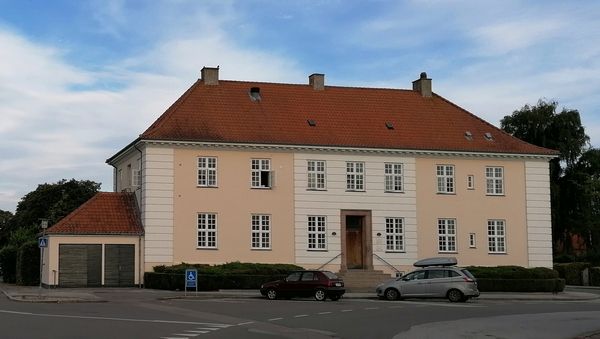
The building in the title image the former post office in Sakskøbing, where I live. (my photo). It’s right next to the train station. Plenty of space for a queue.
Archive photo of the Post Office here. Copyright issues so sorry I could only use my own, recent not very christmassy photo.
You have my permission to read it out loud to an audience live (no recording), provided you credit me for the story.